05
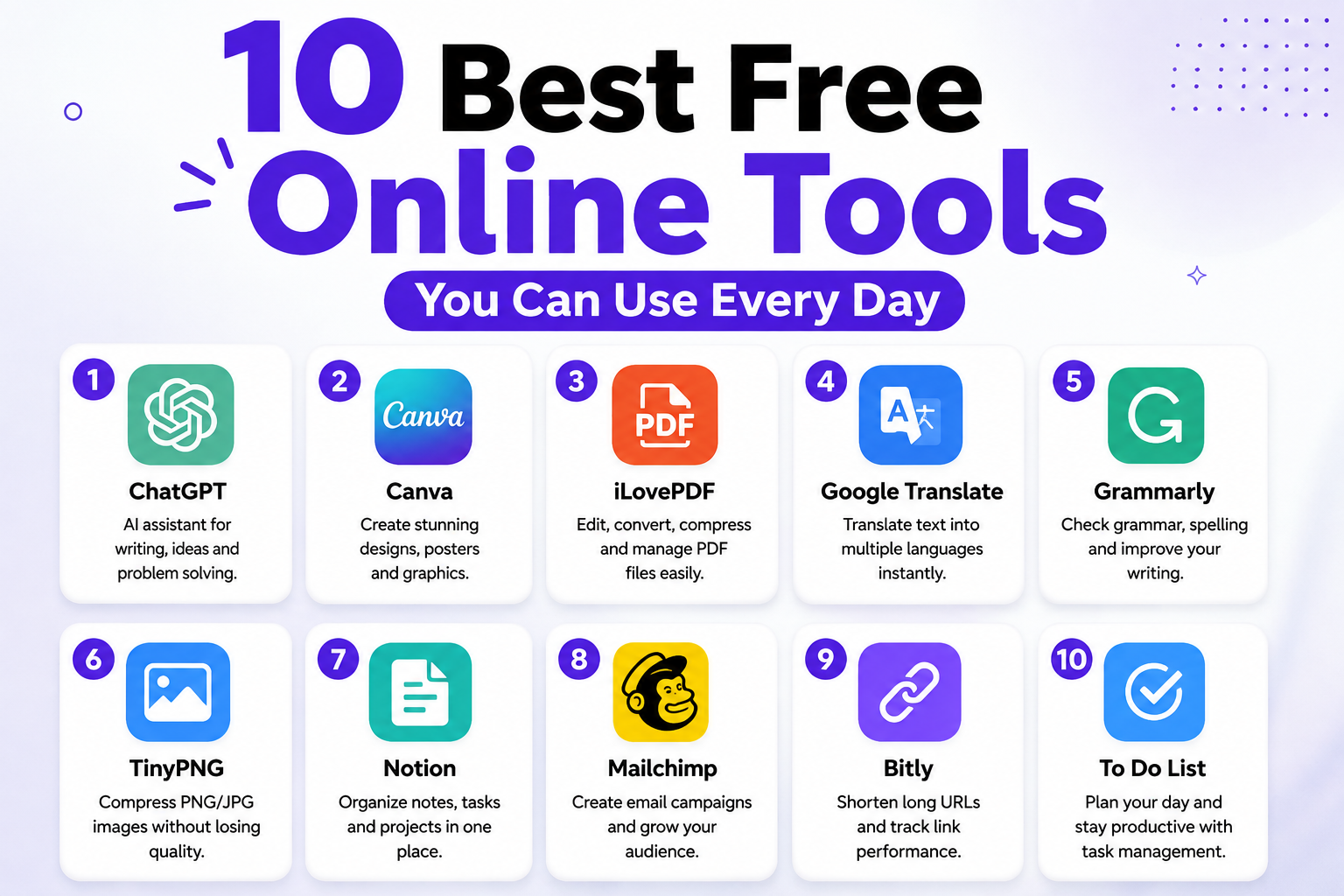
10 Best Free Online Tools You Can Use Every Day
10 Best Free Online Tools
The internet is full of tools that can make everyday tasks faster, easier, and less stressful. Whether you are a student, freelancer, content creator, business owner, office worker, or simply someone who spends a lot of time online, the right online tools can save you hours every week.
The best part is that you do not always need expensive software. Many useful tools are available directly in your browser and can be used for free. There is no complicated installation process, and in many cases, you can start using them within seconds.
From writing and editing text to converting files, creating designs, compressing images, generating passwords, and checking information, free online tools can handle many small jobs that would otherwise take much longer.
In this guide, we’ll look at **10 of the best free online tools you can use every day**. Each tool serves a different purpose, so you can choose the ones that match your daily needs.
Why Use Free Online Tools?
Online tools are useful because they solve specific problems quickly. Instead of downloading a large application just to perform one simple task, you can open a website, complete the job, and move on.
For example, if you need to convert a PDF into another format, you do not necessarily need expensive PDF software. If you want to resize an image, you can use an online image tool. If you need to check your writing, an online grammar checker can help identify common mistakes.
Another major advantage is accessibility. Browser-based tools can usually be accessed from different devices, including computers, tablets, and smartphones.
This makes them particularly helpful for people who work remotely or frequently switch between devices.
What Makes an Online Tool Worth Using?
Not every free tool on the internet is equally useful. A good tool should be easy to understand, reasonably fast, and capable of completing its main task without unnecessary complications.
Privacy is also important. You should always be careful when uploading sensitive documents, personal information, financial records, or confidential business files to an online service.
A useful everyday tool should also have a clear interface. You should not have to spend twenty minutes learning how to perform a task that should take two minutes.
With those points in mind, here are ten practical categories of free online tools worth adding to your daily digital toolkit.
1. Online Word and Character Counter
A **word counter** is one of the simplest online tools, but it can be surprisingly useful. It allows you to quickly check the number of words, characters, sentences, and sometimes paragraphs in a piece of text.
Students can use word counters when completing assignments with minimum or maximum word requirements. Bloggers can use them to estimate article length, while social media users can check character limits before publishing posts.
Writers also benefit from character counting when creating titles, descriptions, advertisements, or short-form content.
What Can You Use a Word Counter For?
A word counter can help with:
* Blog posts
* School assignments
* Essays
* Product descriptions
* Social media posts
* Meta descriptions
* Email writing
* Freelance projects
* Reports
* Short stories
Instead of manually counting words, you can simply paste your text into the tool and receive an instant result.
Why It Is Useful Every Day
Writing is part of many people's daily online activities. Even if you are not a professional writer, you may regularly need to prepare emails, applications, captions, messages, or documents.
A word counter makes it easier to stay within a specific length without wasting time.
2. Online Grammar and Spelling Checker
Small spelling and grammar mistakes can make otherwise good writing look unprofessional. An online grammar checker can help identify common problems before you publish or send something.
These tools typically examine your text for spelling errors, punctuation issues, grammar problems, and awkward wording.
You can use one before sending an important email, publishing a blog post, submitting an assignment, or posting something publicly.
Who Can Benefit From Grammar Checkers?
Almost everyone who writes online can benefit from them.
Students can check essays and reports. Bloggers can review articles before publishing. Businesses can use them when preparing website copy and emails.
Freelancers can also use grammar checkers as an additional proofreading step before delivering work to clients.
A Helpful Final Check
A grammar checker should not completely replace human proofreading. Automated tools can sometimes misunderstand context or suggest changes that do not fit the writer's intended meaning.
The best approach is to use the tool as a second set of eyes. Review its suggestions and decide which changes actually improve your writing.
3. Online Image Compressor
Large image files can slow down websites, consume storage space, and make sharing files more difficult.
An **online image compressor** can reduce the file size of images while attempting to maintain acceptable visual quality.
This is particularly useful for website owners. Smaller images generally require less data to load, which can contribute to a better browsing experience.
Common Uses for Image Compression
You might use an image compressor when:
* Uploading images to a website
* Preparing Pinterest graphics
* Sending images by email
* Sharing photos online
* Reducing storage usage
* Preparing images for a blog
* Optimizing website media
For example, an image that is several megabytes in size may be unnecessarily large for a blog article. Compressing it can make the file much easier to manage.
Check Quality After Compression
Compression is useful, but extremely aggressive compression can reduce image quality.
After processing an image, take a moment to check whether text remains readable and whether important details still look sharp.
4. PDF Converter and PDF Tools
PDF files are everywhere. They are commonly used for documents, applications, reports, invoices, study materials, manuals, and business files.
A free online PDF tool can help you perform common tasks without installing dedicated PDF software.
Depending on the service, you may be able to convert PDFs into editable formats, combine multiple PDF files, split documents, compress files, rotate pages, or convert images into PDFs.
Everyday PDF Tasks
Some of the most common PDF tasks include:
* Combining multiple PDFs
* Splitting large PDFs
* Compressing PDFs
* Converting images to PDF
* Converting PDF pages to images
* Rotating pages
* Rearranging pages
* Extracting selected pages
These tools can be particularly helpful when you need to complete a quick task and do not want to install a desktop application.
Be Careful With Private Documents
Always consider privacy before uploading a document to an online service.
Avoid uploading highly sensitive information unless you understand the site's privacy policies and are comfortable with how your files are handled.
5. Online Image Resizer
Sometimes an image is perfectly good but simply the wrong size.
An online image resizer allows you to change the dimensions of an image without opening complicated photo-editing software.
This can be useful when preparing images for websites, social media platforms, profile pictures, blog posts, advertisements, or online forms.
Why Image Dimensions Matter
Different platforms often work better with different image dimensions. A large photograph may need to be reduced before uploading, while a small graphic might need specific dimensions for a particular design.
Instead of opening a professional editing application, you can use a browser-based resizer for quick adjustments.
Keep the Aspect Ratio in Mind
When resizing an image, maintaining its original aspect ratio is usually important. Otherwise, people and objects may appear stretched or compressed.
If the tool offers an option to lock the aspect ratio, use it unless you specifically need custom dimensions.
6. Online Color Picker
Color plays an important role in websites, graphics, presentations, branding, and social media designs.
An online color picker allows you to identify colors and obtain useful color values such as HEX, RGB, or HSL codes.
This is especially useful for designers and website owners who want to maintain consistent colors across different pages and graphics.
Where Color Pickers Help
You might use a color picker to:
* Match website colors
* Create brand palettes
* Design social media graphics
* Select background colors
* Match text colors
* Build presentation themes
* Recreate a color from an image
For example, if you find a particular shade that you like in an image, a color picker can help identify a similar digital color value.
Create a Consistent Visual Style
Using the same colors repeatedly can make a website or brand look more professional.
You can save your preferred HEX codes and reuse them across graphics, buttons, headings, backgrounds, and other design elements.
7. Online Password Generator
Strong passwords are an important part of online security.
Many people still create passwords using names, birthdays, common words, or simple number combinations. Unfortunately, predictable passwords can be easier to guess or compromise.
An online password generator can create random passwords using combinations of uppercase letters, lowercase letters, numbers, and special characters.
What Makes a Strong Password?
A strong password is generally:
* Long
* Difficult to guess
* Unique
* Not based on personal information
* Not reused across multiple accounts
For important accounts, a password manager can also help you create and store unique passwords.
Don't Reuse Important Passwords
One of the biggest mistakes people make is using the same password everywhere.
If one account is compromised, reused credentials may put other accounts at risk.
For better security, use different passwords for important services and enable two-factor authentication whenever it is available.
8. Online QR Code Generator
QR codes have become a common way to connect physical and digital experiences.
An online QR code generator can create a scannable code that points to a website, document, contact information, social media profile, or other supported content.
You can print the code on flyers, menus, business cards, posters, packaging, or promotional materials.
Everyday Uses for QR Codes
QR codes can be useful for:
* Website links
* Digital menus
* Event registration
* Contact information
* Social media profiles
* Product information
* Download pages
* Online forms
They are convenient because users can scan the code with a smartphone instead of typing a long web address.
Test Before Publishing
Always scan a QR code before printing or publishing it.
Make sure it leads to the correct destination and remains readable when printed at the intended size.
9. Online Unit Converter
Unit conversions can become confusing when working with different measurement systems.
An online unit converter can quickly convert values for length, weight, temperature, area, volume, speed, and other measurements.
For example, you may need to convert kilometers into miles, kilograms into pounds, Celsius into Fahrenheit, or inches into centimeters.
Why Unit Converters Are Handy
Unit converters are useful for:
* Travel planning
* Cooking
* Schoolwork
* Shopping
* Construction
* Fitness calculations
* Engineering tasks
* International communication
Instead of memorizing conversion formulas, you can enter the value and select the units you need.
Double-Check Important Calculations
For casual everyday conversions, an online calculator is usually convenient.
However, if the conversion affects an important engineering, medical, financial, or professional decision, verify the result with a trusted reference or appropriate professional tool.
10. Online File Converter
Different devices and applications often use different file formats. Sometimes you have the right information but the wrong format.
An online file converter can help change files from one supported format to another.
Depending on the service, you may be able to convert documents, images, audio files, videos, or other common formats.
Common File Conversion Tasks
Examples include:
* JPG to PNG
* PNG to JPG
* DOCX to PDF
* PDF to images
* Images to PDF
* TXT to other text formats
* Audio format conversion
* Video format conversion
File conversion is particularly useful when a website, application, or device does not support the original format.
Keep Original Files
Before converting an important file, keep a copy of the original.
This gives you a backup if the converted version loses quality, formatting, metadata, or other information.
How to Choose the Right Free Online Tool
With thousands of online tools available, choosing the right one can sometimes be harder than completing the task itself.
Start by identifying exactly what you need to accomplish.
If you only need to resize an image, look for an image resizer rather than a complete photo-editing platform. If you need to count words, a simple word counter is enough.
Look for a Simple Interface
A good online tool should make its primary function obvious.
You should be able to understand where to upload a file, enter information, or start the process without searching through complicated menus.
Simplicity is especially important for tools you use frequently.
Check Supported Formats
Before uploading a file, check whether the tool supports the format you are working with.
For example, not every image tool supports every image format, and not every PDF converter handles the same types of documents.
Checking compatibility first can save time.
Think About Privacy
Privacy should always be considered when using online tools.
If a service requires you to upload a file, understand what happens to that file after processing.
For ordinary, non-sensitive files, this may not be a major concern. But confidential documents deserve additional caution.
Avoid Unnecessary Downloads
Some websites advertise an online service but then ask users to download unknown programs or browser extensions.
Be careful.
If a simple task can be completed directly in the browser, you may not need additional software.
Only install applications from sources you trust.
Benefits of Building Your Own Online Tool Collection
Once you find a few reliable tools, you can create your own collection of favorites.
This can significantly improve your daily workflow.
For example, a content creator might regularly use a word counter, grammar checker, image compressor, image resizer, and QR generator.
A student might frequently use a word counter, PDF converter, unit converter, and grammar checker.
A website owner could benefit from image compression, image resizing, color picking, PDF tools, and file conversion.
The important thing is not to collect dozens of tools simply because they are available. Keep the ones that genuinely save you time.
Free Tools Can Save More Than Money
The obvious benefit of free online tools is that they can reduce software costs.
But saving money is not their only advantage.
They can also save time.
Imagine spending fifteen minutes searching for a suitable desktop application, downloading it, installing it, creating an account, and figuring out its interface just to resize one image.
An online resizer might complete the same task in a minute.
Those small time savings add up.
If you perform ten small digital tasks every day, reducing each task by just a few minutes can make a noticeable difference over the course of a month.
Are Free Online Tools Safe?
Free does not automatically mean unsafe, but it also does not guarantee quality.
Before using an unfamiliar service, look at the website carefully. Check whether the company provides information about privacy, data handling, and terms of use.
Be especially careful with tools that request sensitive information.
Do not upload passwords, financial documents, identity information, private business files, or other confidential material to random websites.
For security-related tasks, use reputable services and follow standard security practices.
Tips for Using Online Tools More Efficiently
There are a few simple habits that can make online tools even more useful.
First, bookmark the services you use regularly. This eliminates the need to search for them every time.
Second, learn the basic features of your favorite tools. You may discover shortcuts or options that make your workflow faster.
Third, avoid using a complicated tool when a simple one will do the job.
Finally, always review the result before using it for something important.
Automation is convenient, but human judgment still matters.
Final Thoughts
Free online tools can make everyday digital tasks much easier.
You do not need expensive software for every little job. A reliable browser-based tool can often handle simple tasks such as counting words, checking grammar, compressing images, resizing photos, converting files, generating QR codes, and performing unit conversions.
The ten categories covered in this guide are useful for a wide range of people. Students can use them for assignments, freelancers can use them for client work, website owners can use them for content and media management, and everyday internet users can use them to solve small problems quickly.
The key is to choose tools carefully.
Look for services that are simple, reliable, transparent about privacy, and focused on doing one job well. Keep your favorite tools bookmarked so they are always within reach.
You may be surprised by how much time a few good online tools can save.
Instead of searching for a complicated solution every time you encounter a small digital problem, build your own collection of useful tools and make them part of your daily workflow.
Frequently Asked Questions
1. What are free online tools?
Free online tools are web-based services that allow you to complete specific tasks directly from your browser without installing expensive software. Examples include word counters, image compressors, PDF converters, grammar checkers, and unit converters.
2. What are the best free online tools for everyday use?
Some of the most useful everyday tools include word counters, grammar checkers, image compressors, image resizers, PDF converters, QR code generators, color pickers, password generators, unit converters, and file converters.
3. Can I use free online tools on my smartphone?
Yes. Most browser-based online tools can be accessed from smartphones and tablets. Simply open the tool's website through your mobile browser and use its available features.
4. Are free online tools safe to use?
Many free online tools are safe, but you should always check the website's reputation and privacy policy. Avoid uploading sensitive or confidential documents to websites you do not trust.
5. Do free online tools require software installation?
Usually, no. One of the biggest advantages of online tools is that they work directly through a web browser. You can complete your task without downloading a desktop application.
6. Can online tools help students?
Absolutely. Students can use free online tools for counting words, checking spelling and grammar, converting files, creating PDFs, converting measurements, resizing images, and completing other everyday academic tasks.
7. Are free online tools useful for bloggers and website owners?
Yes. Bloggers and website owners can use tools such as image compressors, image resizers, word counters, grammar checkers, color pickers, PDF converters, and QR code generators to improve their content workflow.
8. Can online tools save time?
Yes. A specialized online tool can often complete a simple task within seconds. Instead of installing complicated software, you can open a browser tool, complete the task, and continue working.
9. What should I consider before choosing an online tool?
Consider ease of use, available features, supported file formats, privacy practices, processing limits, and whether the tool actually solves your problem. For important work, choose a reliable and reputable service.
10. Which free online tool is the most useful?
There is no single tool that is best for everyone. The most useful option depends on your needs. Writers may prefer word counters and grammar checkers, while designers may rely more on image tools and color pickers.
Contact
Missing something?
Feel free to request missing tools or give some feedback using our contact form.
Contact Us